Which Candle Wax Is Best? Comparing Beeswax, Soy, Coconut & More for Burn Time & Scent
Candles are more than just a source of light—they set the mood, create ambiance, and even add a touch of wellness to your space. But when it comes to finding the best candle wax, not all options are created equal. From natural beeswax to trendy soy and luxurious coconut, the type of wax you choose impacts burn time, scent throw, sustainability, and cost. Whether you’re shopping for candles or making your own, understanding which is the best candle wax will help you create the perfect glow at home.
1. Paraffin Wax: The Classic Choice
Overview: Paraffin wax is one of the most widely used candle wax types. As a byproduct of petroleum refining, it’s affordable and easy to find.
- Burn Time: Shorter compared to natural waxes.
- Cost: Very affordable.
- Sustainability: Not considered eco-friendly since it comes from non-renewable petroleum.
- Best For: Strong scent throw. Paraffin holds fragrance and color exceptionally well, which is why it’s popular in scented candles.
If cost and fragrance strength matter most, paraffin is an option—but it’s not the right candle wax if you care about sustainability.

2. Soy Wax: The Eco-Friendly Favorite
Overview: Soy wax, made from hydrogenated soybean oil, is one of the most popular choices for those seeking the best candle wax for scented candles.
- Burn Time: Longer than paraffin, with an even and slow burn.
- Cost: Moderately priced—more expensive than paraffin but cheaper than beeswax.
- Sustainability: Very eco-friendly, biodegradable, and renewable.
- Best For: Scented candles. Soy wax is plant-based and has a good “scent throw” when warmed.
Soy is often considered the best candle wax for everyday use since it balances affordability, eco-friendliness, and fragrance performance.

3. Beeswax: The Natural Luxury
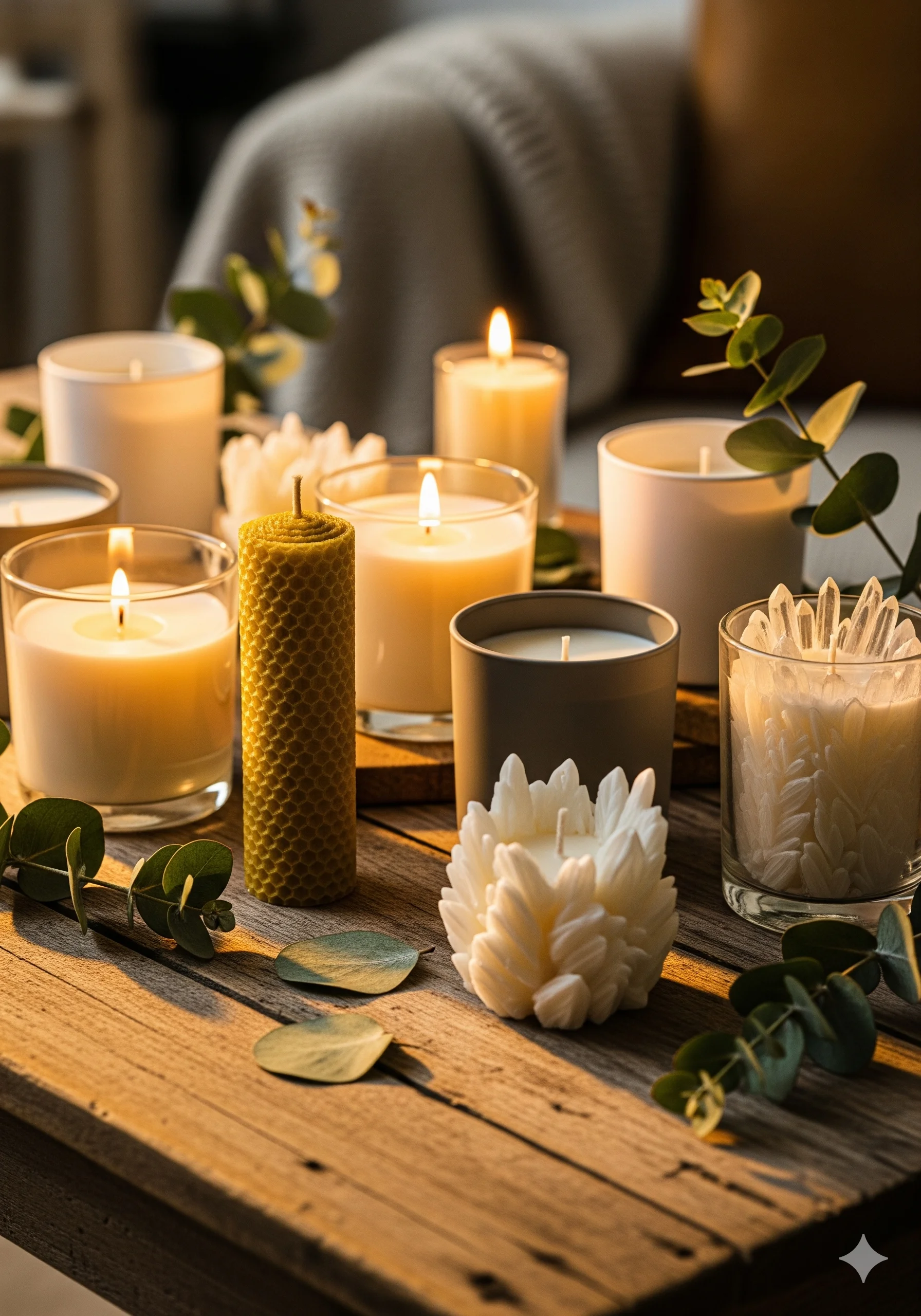
Overview: Beeswax is one of the oldest types of candle wax, used for centuries. Naturally produced by honeybees, it has a subtle honey-like aroma.
- Burn Time: Longest-lasting candle wax. Beeswax burns much slower than paraffin and soy.
- Cost: The most expensive due to its natural harvesting process.
- Sustainability: Extremely eco-friendly and non-toxic.
- Best For: Clean burning. Beeswax is a natural wax known for its long burn time, though it doesn’t hold added fragrances as well as soy or paraffin.
If you want the best candle wax for longevity, beeswax is unbeatable—though not ideal for strong scented candles. Beeswax is a natural byproduct of honey production, and according to the National Honey Board, it has been used for centuries in candle making.

4. Coconut Wax: The Rising Star
Overview: Made from coconut oil, coconut wax is a newer, premium option in the candle world. It’s creamy, smooth, and sustainable.
- Burn Time: Longer than soy but slightly less than beeswax.
- Cost: High-end and often blended with soy to reduce price.
- Sustainability: Highly sustainable and renewable.
- Best For: Luxury scented candles. Coconut wax has one of the best scent throws while still being eco-friendly.
Many candle lovers consider coconut one of the best candle wax types for scent and sustainability, especially in high-end candles.

5. Palm Wax: The Decorative Option
Overview: Palm wax is made from palm oil and creates unique crystalline or feathered textures, making it visually beautiful.
- Burn Time: Long, similar to soy.
- Cost: Moderate.
- Sustainability: Questionable—depends on whether the palm oil is sustainably sourced.
- Best For: Decorative and textured candles. Holds fragrance well but often criticized for its environmental impact.
Palm wax can be the ideal candle wax for decorative designs, but always look for sustainably sourced options.

Which Candle Wax Lasts the Longest?
- Beeswax lasts the longest, followed by coconut and soy.
- Paraffin burns the fastest.
Which Candle Wax Is the Most Sustainable?
- Soy, coconut, and beeswax are the most eco-friendly candle waxes.
- Paraffin ranks lowest for sustainability.
Which Candle Wax Is the Most Costly?
- Beeswax and coconut are the most expensive.
- Paraffin is the cheapest, while soy is middle ground.
Which Wax Is Best for Scented Candles?
- Soy and coconut are the best wax for scented candles.
- Paraffin holds fragrance strongly but is not eco-friendly.

Final Thoughts
You can also consider how different materials impact indoor air quality, as explained by the U.S. Environmental Protection Agency. So, which candle wax is best? The answer depends on your priorities:
- For affordability and strong scent → Paraffin
- For eco-friendly and scented candles → Soy
- For luxury and sustainability → Coconut
- For longest-lasting and natural → Beeswax.
Understanding the different types of candle wax helps you choose the right one for your needs—whether you’re buying a cozy scented candle for your home or experimenting with DIY candle making.
Choosing a Wax by Candle Type
The shape of the candle is a helpful place to start, because each format asks something different of the wax. Container candles need a wax that softens evenly across the jar and clings to the sides as it cools, so the surface stays smooth and the melt pool spreads gently. Softer waxes and blends are often chosen for jars for this reason, while very hard waxes can pull away from the glass.
Freestanding candles ask for the opposite qualities. Pillars, tapers, and molded shapes need a firmer wax that holds an edge, releases cleanly from a mold, and keeps its shape on the shelf. Votives sit between the two, since they are burned inside a holder but still need enough firmness to handle. Wax melts need no wick at all, so makers can choose wax mainly for how it holds and releases fragrance in a warmer.
Why Makers Blend Waxes
Many candles on shelves and in craft studios are not made from a single wax at all. Blending lets a maker borrow the strengths of one wax to soften the weaknesses of another. A soft, creamy wax that carries fragrance beautifully may be blended with a firmer wax so the finished candle keeps a smooth top and a tidy shape. A hard wax with a lovely finish may be blended with a softer one so it melts more evenly in a jar.
Blending is also a practical way to balance cost, appearance, and how a candle behaves while burning, without giving up the character of the main wax. There is no single correct blend, because the right mix depends on the candle being made and the result the maker wants. This is why two candles that list the same headline wax can still look, feel, and burn a little differently from each other.
Storing Wax and Finished Candles
Good storage keeps wax ready to use and finished candles looking their best. Unused wax keeps well in a cool, dry place away from direct sunlight and strong odors, since wax can pick up scents from its surroundings. Keep different waxes in separate, labeled containers or bags so types and fragrance loads are never mixed up by accident, and keep flakes and blocks off the floor where dust and moisture gather.
Finished candles deserve the same care. Store them upright, out of warm spots and bright light, which can fade color and soften surfaces. A lid, box, or wrap keeps dust off the top, so the first burn stays clean. Fragranced candles keep their scent better when they are covered and kept apart from strongly scented items. With simple storage, both supplies and finished candles stay fresh, tidy, and ready to enjoy.
Troubleshooting Common Candle-Making Problems
Even careful makers meet a few familiar problems. Rough or uneven tops often appear as a candle cools, and gentle warmth across the surface can smooth them again. Small cracks or sinkholes near the wick are usually signs the wax shrank while setting; a careful second pour or a little reserved wax can level them. Wet spots, where wax pulls away from the glass, are common and mostly cosmetic.
Other problems show up while burning. A faint scent often means the fragrance was not suited to the wax or the candle needs a longer cure before lighting. Tunneling, where wax melts down the middle and leaves a wall of wax behind, usually points to a wick that is too small for the container. A flickering, smoky flame often means the wick needs trimming or the candle is sitting in a draft.
Comparing Candles Side by Side in Words
Reading about wax is useful, but a small side by side test teaches more than any description. Choose two candles of a similar size and style, light them in the same room at different times, and notice the same things about each: how the melt pool spreads, how the flame behaves, how the scent fills the space, and how the surface looks once cool.
Writing down simple notes keeps the comparison honest, because memory favors whichever candle burned most recently. Note which wax felt cleaner, which scent carried further, and which candle you would choose again for that room. Over a few comparisons, a clear pattern appears, and the best wax stops being a guess and becomes a preference you can explain.