
Scandinavian Garden Style: Light, Airy and Functional
Scandinavian garden style is not simply a garden filled with pale furniture, gravel, and a few ornamental grasses. At its best, it is a practical way of designing an outdoor space around simplicity, natural materials, comfort, and everyday use.
The Scandinavian approach works especially well if you want a garden that feels calm rather than busy, modern without looking harsh, and beautiful without requiring constant styling.
The key is restraint. Instead of asking, “What else can I add?”, Scandinavian garden design asks, “What does this space actually need?”
That makes it particularly useful for small backyards, patios, courtyards, and gardens where you want every square foot to have a purpose.
What Is Scandinavian Garden Style?
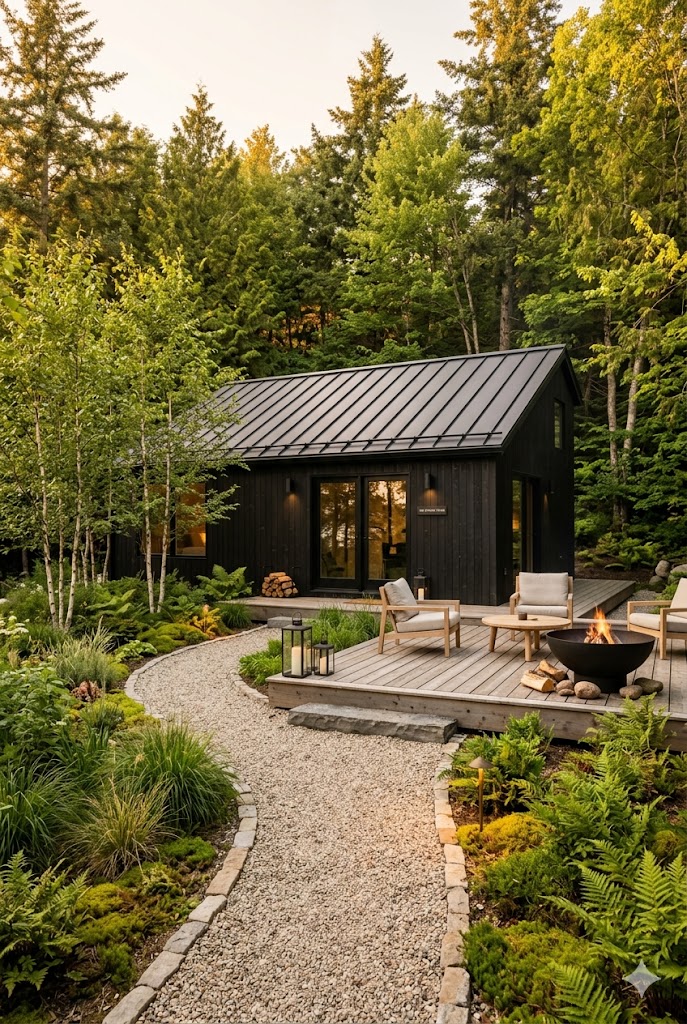
A Scandinavian garden combines minimalist landscaping with natural, comfortable outdoor living. Its appearance is influenced by Nordic design principles: clean lines, muted colors, functional furniture, natural textures, and a strong connection with the surrounding landscape.
But there is an important distinction between Scandinavian and strictly minimalist garden design.
A minimalist garden may prioritize visual simplicity above everything else. A Scandinavian garden puts comfort alongside simplicity.
That means a wooden bench might have a soft cushion, a patio might include a warm outdoor rug, and an otherwise simple seating area may have lanterns or a fire pit.
Think:
simple structure + natural materials + useful spaces + cozy details.
If you like uncluttered gardens but don’t want them to feel cold, Scandinavian style is a particularly good direction.
The Five Elements That Make the Style Work
You do not need every Scandinavian garden feature to achieve the look. In fact, adding too many can make the space feel themed rather than natural.
Instead, concentrate on five elements:
- A restrained color palette
- Natural materials
- Simple planting
- Functional zones
- Warmth through texture and lighting
If your garden already has three or four of these, you may only need a few targeted changes rather than a complete redesign.
1. Start With Function Before Choosing Décor
The most important Scandinavian garden decision is not the furniture color or plant selection. It is deciding how you will actually use the space.
Before buying anything, ask:
- Do I mainly want outdoor dining?
- Do I need a quiet place to sit?
- Will children use the garden?
- Do I entertain frequently?
- Is the garden mainly viewed from indoors?
- How much maintenance am I realistically willing to do?
Your answer should determine the layout.
For example, if you regularly eat outdoors, give the dining area the best location rather than squeezing a table into whatever space remains.
If you mainly want somewhere to relax, a comfortable lounge area is more valuable than a large dining set.
A Simple Decision Rule
Choose the activity first, furniture second, and decoration last.
This prevents one of the most common garden-design mistakes: buying attractive pieces that do not work together or do not suit the way you live.
2. Choose a Color Palette That Keeps the Garden Airy
Scandinavian outdoor spaces generally rely on colors found in nature rather than a large collection of decorative shades.
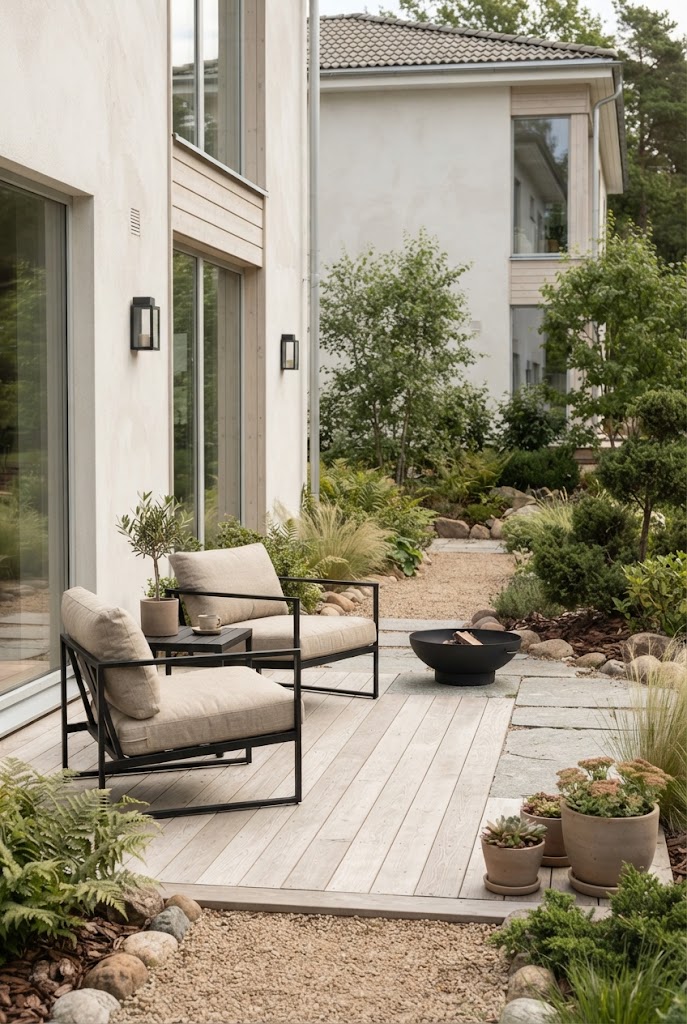
A useful base palette might include:
| Base | Supporting Color | Accent |
|---|---|---|
| Warm white | Soft gray | Charcoal |
| Sand beige | Sage green | Black |
| Pale wood | Muted green | Terracotta |
| Light gray | Olive | Deep brown |
You don’t have to make everything white or gray.
In fact, too much white can make an outdoor space feel stark, particularly when there is little greenery.
What Should You Choose?
If your garden receives plenty of sunlight, warm neutrals such as beige, sand, and natural wood usually feel more inviting.
If the garden is shaded, lighter surfaces and pale gray furniture can help prevent it from feeling visually heavy.
For a small garden, keep the hardscape and furniture within a narrow color range. Fewer competing colors make the space appear more cohesive and often make it feel larger.
3. Use Wood and Stone to Add Warmth
Natural materials are one of the easiest ways to make Scandinavian garden design feel authentic rather than overly minimalist.
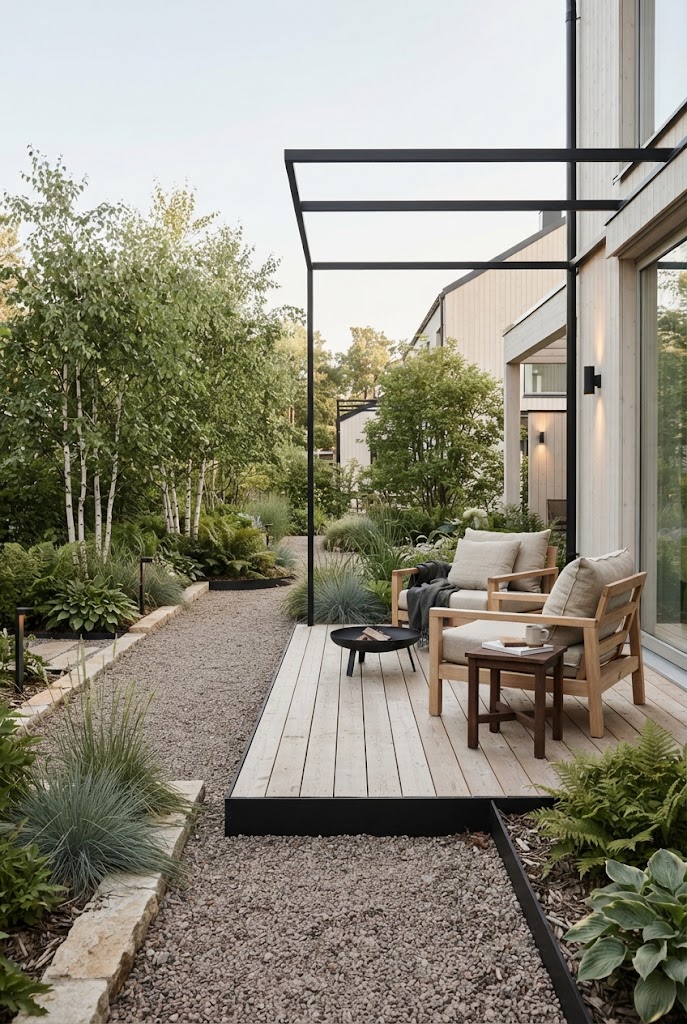
Wood works particularly well for:
- Decking
- Benches
- Pergolas
- Raised planters
- Privacy screens
- Dining furniture
Stone and gravel can be used for:
- Pathways
- Seating areas
- Borders
- Drainage-friendly surfaces
The best combinations are usually simple.
For example:
pale wood + gray gravel + green planting
or
dark-stained wood + light stone + soft grasses
You do not need five different materials competing for attention.
Which Wood Finish Is Best?
For a lighter Nordic appearance, choose natural or pale wood.
For a more contemporary Scandinavian garden, combine natural wood with matte black metal.
If you want a softer, rustic interpretation, weathered timber works beautifully.
The decision should depend on your home’s exterior. The garden will look more intentional if its materials visually connect with the architecture.
4. Keep the Planting Natural, Not Empty
This is where Scandinavian gardens can easily go wrong.
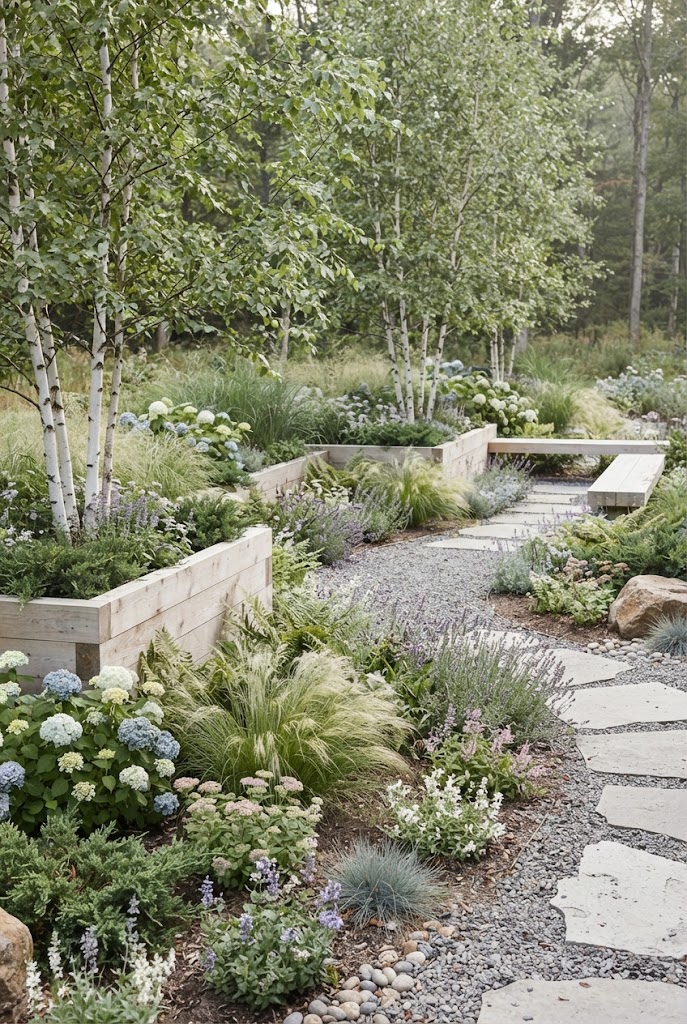
Minimalism does not mean planting almost nothing.
A garden with too much empty gravel, one sculptural tree, and a couple of pots may look minimalist in a photograph but can feel sterile in real life.
Instead, use fewer plant varieties and repeat them throughout the garden.
Good choices include:
- Ornamental grasses
- Ferns
- Birch
- Lavender
- Hydrangeas
- Herbs
- Evergreen shrubs
- Soft perennial flowers
The exact plants should depend on your climate and growing conditions. The Scandinavian look is more important than copying plants from Nordic countries that may struggle in your environment.
A Better Planting Strategy
Choose:
1–2 structural plants + 2–3 repeating soft-texture plants + seasonal accents.
Repeating the same plants in several areas creates visual rhythm without making the garden feel overly designed.
If you live in a hot climate, for example, you can interpret the Scandinavian aesthetic using climate-appropriate grasses, shrubs, herbs, and drought-tolerant plants rather than forcing a traditional Nordic plant palette.
5. Make Outdoor Seating the Heart of the Garden
A Scandinavian garden should encourage you to actually spend time outside.
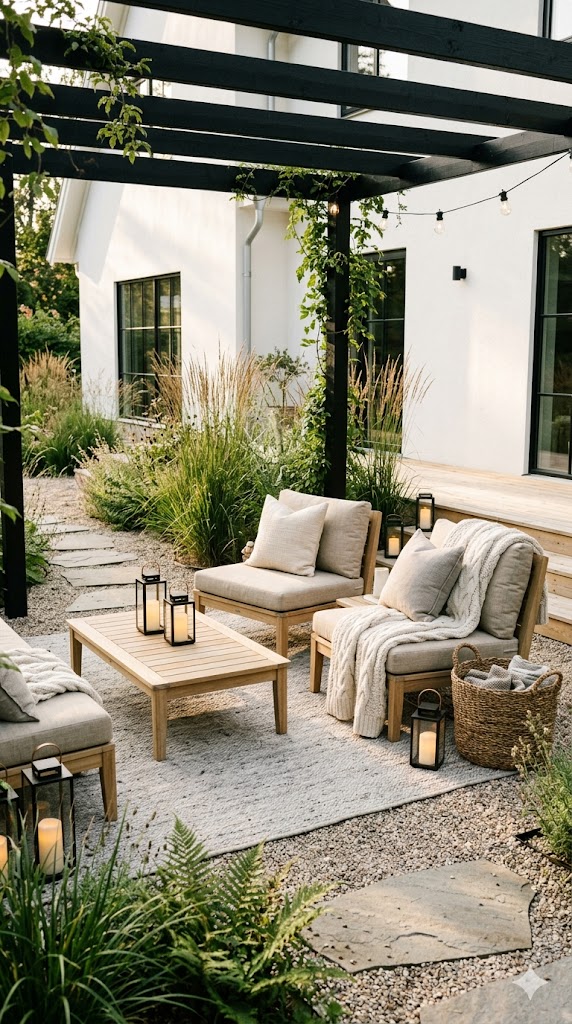
That makes seating more important than decorative objects.
Look for furniture with:
- Simple silhouettes
- Natural wood
- Neutral upholstery
- Comfortable proportions
- Durable outdoor construction
A wooden bench is a good choice when space is limited because it can serve both as seating and as a visual architectural element.
For larger gardens, a combination of lounge chairs and a small coffee table can create a more relaxed outdoor living room.
Which Seating Should You Choose?
For small patios: choose a compact bistro set or bench.
For family gardens: choose a durable dining table with comfortable chairs.
For entertaining: choose modular lounge seating that can be rearranged.
For quiet gardens: choose one excellent chair or loveseat rather than filling the area with furniture.
The goal isn’t to create an outdoor furniture showroom. It is to create one genuinely useful place to sit.
6. Add Hygge Without Overdecorating
The cozy side of Scandinavian design is often associated with hygge, but you don’t need piles of blankets and candles to achieve it.
Instead, introduce warmth through texture.
Try:
- Linen cushions
- Woven outdoor rugs
- Wooden surfaces
- Soft throws
- Lanterns
- Warm lighting
- A fire pit
Choose two or three of these rather than all of them.
A useful rule is:
If the garden already feels comfortable, stop decorating.
Scandinavian style depends on knowing when enough is enough.
7. Choose Garden Lighting for Atmosphere, Not Brightness
Outdoor lighting should extend the usefulness of the garden after sunset without turning it into a brightly illuminated commercial space.
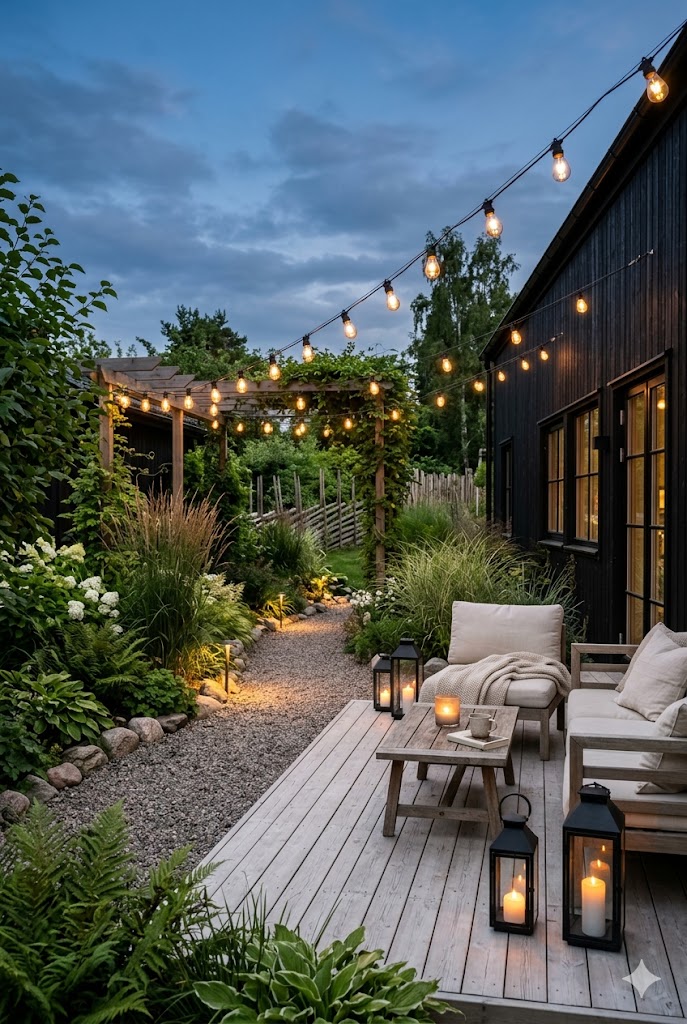
Use different types of lighting for different purposes.
| Lighting | Best For |
|---|---|
| Path lights | Safety and navigation |
| Wall lights | Entrances and dining areas |
| Lanterns | Atmosphere |
| String lights | Seating and entertaining |
| Spotlights | Trees or architectural features |
| Candles | Intimate seating areas |
Warm light generally works better than harsh, cool white light for a Scandinavian-inspired outdoor space.
Rather than lighting everything, highlight the places you want people to notice.
A softly lit tree, seating area, and pathway can create more atmosphere than a garden covered in bright lights.
8. Design Small Scandinavian Gardens Differently
Scandinavian style is particularly effective in small spaces because its minimalist principles naturally reduce visual clutter.
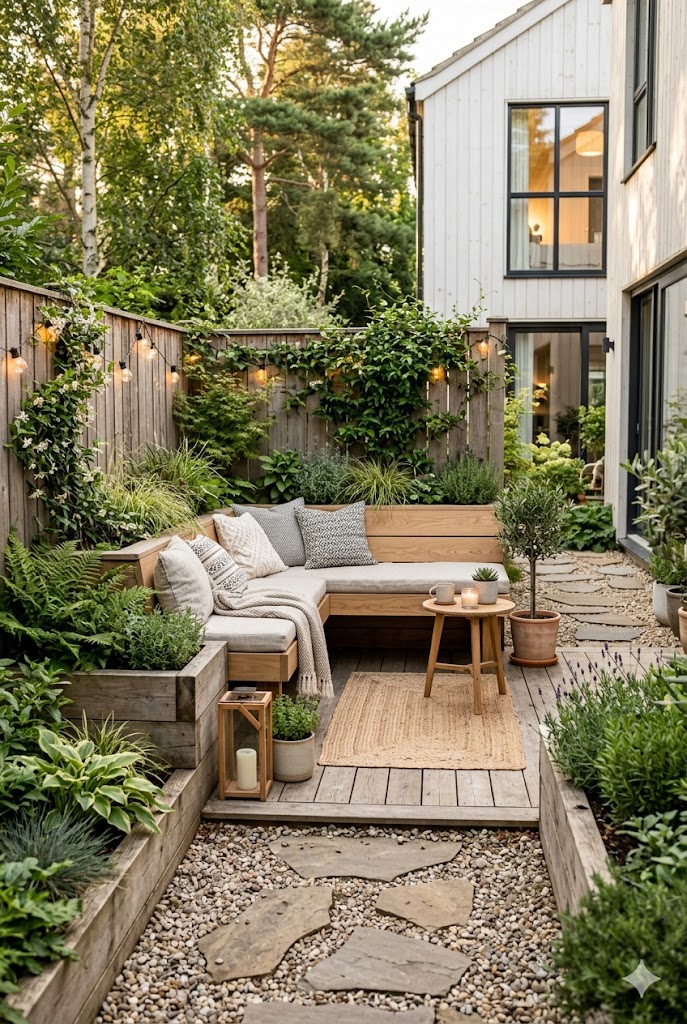
But don’t try to squeeze a full backyard into a tiny courtyard.
Instead, give the space one primary purpose.
For example:
Small courtyard → dining area
Narrow garden → lounge bench
Tiny balcony → compact seating + vertical planting
Small patio → fire pit + two comfortable chairs
Use vertical elements such as trellises, climbing plants, or narrow planters when floor space is limited.
Keep the ground surface visually simple. Too many different paving materials can make a small garden look fragmented.
9. How to Make a Scandinavian Garden Feel Less Cold
This is probably the most important styling problem to solve.
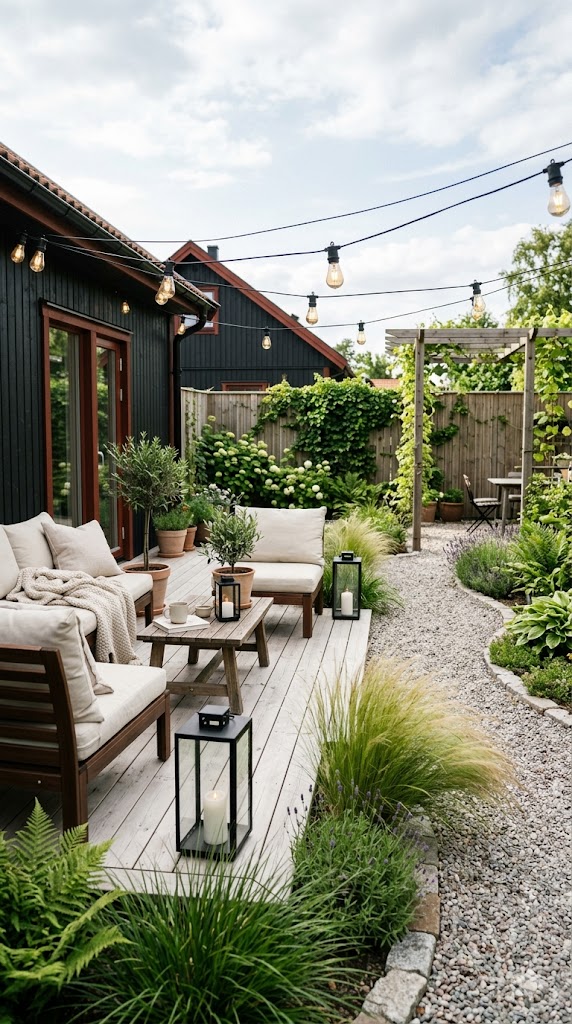
Scandinavian design can become cold when everything is:
- White
- Gray
- Geometric
- Bare
- Highly polished
The solution is not more decoration. It is more texture and natural variation.
Combine:
smooth stone + rough wood
linen + metal
soft grasses + structured paving
warm lighting + cool neutrals
These contrasts give the garden depth without sacrificing simplicity.
If your garden currently feels too stark, add a wooden element or more greenery before adding decorative accessories.
10. What to Prioritize on Different Budgets
You don’t need to redesign everything at once.
On a Small Budget
Focus on:
- Reorganizing the layout
- Repeating a few plants
- Adding gravel or a simple pathway
- Updating cushions
- Introducing warm solar lanterns
These changes can alter the overall feeling without major construction.
On a Medium Budget
Prioritize:
- Quality outdoor seating
- A wooden deck or platform
- Raised planters
- Better lighting
- A defined dining or lounge zone
On a Larger Budget
Invest in elements that are difficult to change later:
- High-quality decking
- Stone paving
- Built-in seating
- Pergolas
- Outdoor kitchens
- Integrated lighting
- Structural planting
A good rule is to spend more on permanent elements and less on seasonal decoration.
Scandinavian Garden Style: What to Skip
You don’t need to follow every Nordic garden trend.
Avoid:
- Too many decorative objects
- Excessive white furniture
- Large collections of mismatched pots
- Artificial-looking planting
- Several competing paving materials
- Furniture that is beautiful but uncomfortable
- Plants chosen only because they look Scandinavian
- Lighting that is too bright
- Empty spaces created simply for the sake of minimalism
The goal is not to make your garden look like a Scandinavian showroom.
It should look like your garden, simplified and thoughtfully organized.
A Simple Formula for Designing Your Own Scandinavian Garden
If you’re starting from scratch, use this sequence:
Step 1: Decide how you will use the garden
Choose dining, relaxing, entertaining, gardening, or a combination.
Step 2: Create one clear functional zone
Don’t try to make every part of the garden equally important.
Step 3: Select two or three main materials
For example, wood, gravel, and stone.
Step 4: Choose a restrained color palette
Use neutrals as the foundation and greenery as the main natural color.
Step 5: Repeat your planting
Repetition creates cohesion.
Step 6: Add comfortable furniture
Prioritize comfort over appearance.
Step 7: Introduce warmth
Use lighting, texture, and perhaps a fire feature.
Step 8: Stop before it becomes cluttered
Leave some visual breathing room.
This approach gives you a Scandinavian garden without requiring every item to be specifically labeled “Nordic.”
Is Scandinavian Garden Style Right for You?
Choose this style if you want a garden that is:
- Easy to visually maintain
- Calm rather than colorful
- Modern but not overly formal
- Comfortable for everyday use
- Built around natural materials
- Adaptable to small spaces
- Relatively uncluttered
It may not be the best choice if you love densely planted cottage gardens, highly colorful tropical landscapes, or elaborate formal gardens.
The biggest advantage of Scandinavian garden design is that you can adapt the principles rather than copy a specific look.
Use the layout ideas, restrained palette, natural materials, and functional approach, then choose plants and finishes that suit your climate, home, and lifestyle.
Find Artwork for Your Space
Looking for artwork to complete your space? Visit Rose Glyde Studio to explore our collection of printable wall art, botanical designs, elegant illustrations, and nature-inspired digital artwork for creating a beautiful gallery wall at home.
Final Thoughts
A successful Scandinavian garden is less about buying Scandinavian-looking furniture and more about making better design decisions.
Start with how you want to use the space. Keep the materials limited, choose plants for your actual climate, invest in comfortable seating, and use lighting to create warmth after dark.
Then leave enough space for the garden to breathe.
That balance between function, simplicity, natural beauty, and comfort is what makes Scandinavian garden style so appealing. Instead of constantly adding new décor, you create an outdoor space where fewer, better choices make the entire garden feel more peaceful and intentional.
Explore More Modern Garden Styles
If you love the sleek, urban elegance of Singapore-style vertical gardens, you’ll also enjoy exploring other modern minimalist garden styles. From clean-lined courtyards to contemporary rooftop retreats, these design ideas focus on simplicity, functionality, and greenery in harmony with architecture.
Check out our detailed guide here: 8 Modern Minimalist Garden Styles for inspiration to bring modern, stylish greenery into every corner of your home.
FAQ: Scandinavian Garden Style: Light, Airy and Functional
What is Scandinavian garden style?
Scandinavian garden style combines minimalist landscaping with natural, comfortable outdoor living — clean lines, muted colors, and functional furniture shaped by Nordic design principles. The key distinction from strict minimalism is that a Scandinavian garden puts comfort alongside simplicity, so a wooden bench gets a soft cushion and a patio includes a warm outdoor rug. Think of it as simple structure + natural materials + useful spaces + cozy details.
How do I keep a Scandinavian garden from feeling cold?
When everything is white, gray, geometric, and bare, the design can feel cold — and the solution is more texture and natural variation, not more decoration. Combine contrasting pairs like smooth stone with rough wood, linen with metal, soft grasses with structured paving, and warm lighting with cool neutrals. If the garden feels too stark, add a wooden element or more greenery before reaching for decorative objects.
What plants work best in a Scandinavian garden?
Minimalism does not mean planting almost nothing — instead, use fewer plant varieties and repeat them throughout the garden. Good choices include ornamental grasses, ferns, birch, lavender, hydrangeas, herbs, evergreen shrubs, and soft perennial flowers. A useful strategy is 1–2 structural plants + 2–3 repeating soft-texture plants + seasonal accents, chosen for your climate rather than copied from Nordic countries.
How should I light a Scandinavian garden?
Outdoor lighting should extend the garden’s usefulness after sunset without turning it into a brightly lit stage — use lighting for atmosphere, not brightness. Path lights guide movement safely, wall lights suit entrances and dining areas, lanterns and string lights create atmosphere, and spotlights highlight trees or features. Warm light works better than harsh cool white, and a softly lit tree, seating area, and pathway create more atmosphere than bright floodlights.
Can I create a Scandinavian garden on a small budget?
You don’t need to redesign everything at once — on a small budget, focus on reorganizing the layout, repeating a few plants, adding gravel or a simple pathway, updating cushions, and introducing warm solar lanterns. These changes can alter the overall feeling without major construction. As a rule, spend more on permanent elements and less on seasonal decoration.




2 Comments